Project manager roles and responsibilities cover everything needed to take a project from idea to delivery: defining scope, building the plan, assigning resources, controlling time and budget, managing risk, keeping stakeholders informed, assuring quality, and formally closing the work. The project manager is accountable for delivering agreed outcomes on time, within budget, and to the required quality.
Project managers oversee every aspect of a project, from the initial planning stages to final delivery. They manage the project's scope, schedule, and budget while also leading teams, allocating resources, and addressing potential risks. A clear understanding of these duties helps aspiring project managers, and the organizations that hire them, set the right expectations from day one.
This guide breaks down the 10 core duties, the skills behind them, how the role differs from a project coordinator, a sample job description, and practical steps to move into the role in 2026.
What Is a Project Manager?
A project manager is a professional responsible for planning, executing, and closing projects. They ensure that a project meets its goals, stays within budget, and is completed on time. Project managers oversee all aspects of a project, including defining its scope, managing resources, leading the project team, monitoring progress, and mitigating risks.
They act as the central point of communication between stakeholders and the project team, ensuring that everyone is aligned with the project objectives. The role is essential in driving the project to success, balancing competing demands, and navigating challenges.
Demand for the role remains strong. The U.S. Bureau of Labor Statistics (BLS) reports that project management specialists earned a median annual wage of $102,320 in May 2025, and it projects employment to grow 7 percent from 2025 to 2035, with about 76,500 openings each year, according to the BLS Occupational Outlook.
Earnings vary widely by industry, experience, location, and certification. For a detailed breakdown, see this guide to project manager salary levels.
What Does a Project Manager Do?
A project manager turns a goal into a finished deliverable. They set objectives, define scope, build the plan, assign work, track progress against the schedule and budget, resolve problems, keep stakeholders informed, and close the project formally. The work shifts with each phase of the project life cycle, but accountability for the outcome stays the same.
Their responsibilities begin with setting clear objectives and defining the project's scope. They then create a detailed project plan, which includes scheduling, budgeting, and resource allocation, serving as a blueprint for the entire project.
As the project progresses, the project manager continuously monitors its status, tracking key milestones and ensuring the project stays on course. If issues arise, they adjust quickly, whether by reallocating resources, revising timelines, or applying risk responses to limit setbacks.
Strong communication sits at the center of the job. The project manager is the main point of contact between the project team, stakeholders, and sometimes clients, which involves regular updates, addressing concerns, and maintaining a collaborative environment where the team feels supported and motivated.
Project Manager Responsibilities by Project Phase
The table below maps the role to the five process groups traditionally described by the Project Management Institute (PMI), showing what the project manager does and produces at each stage.
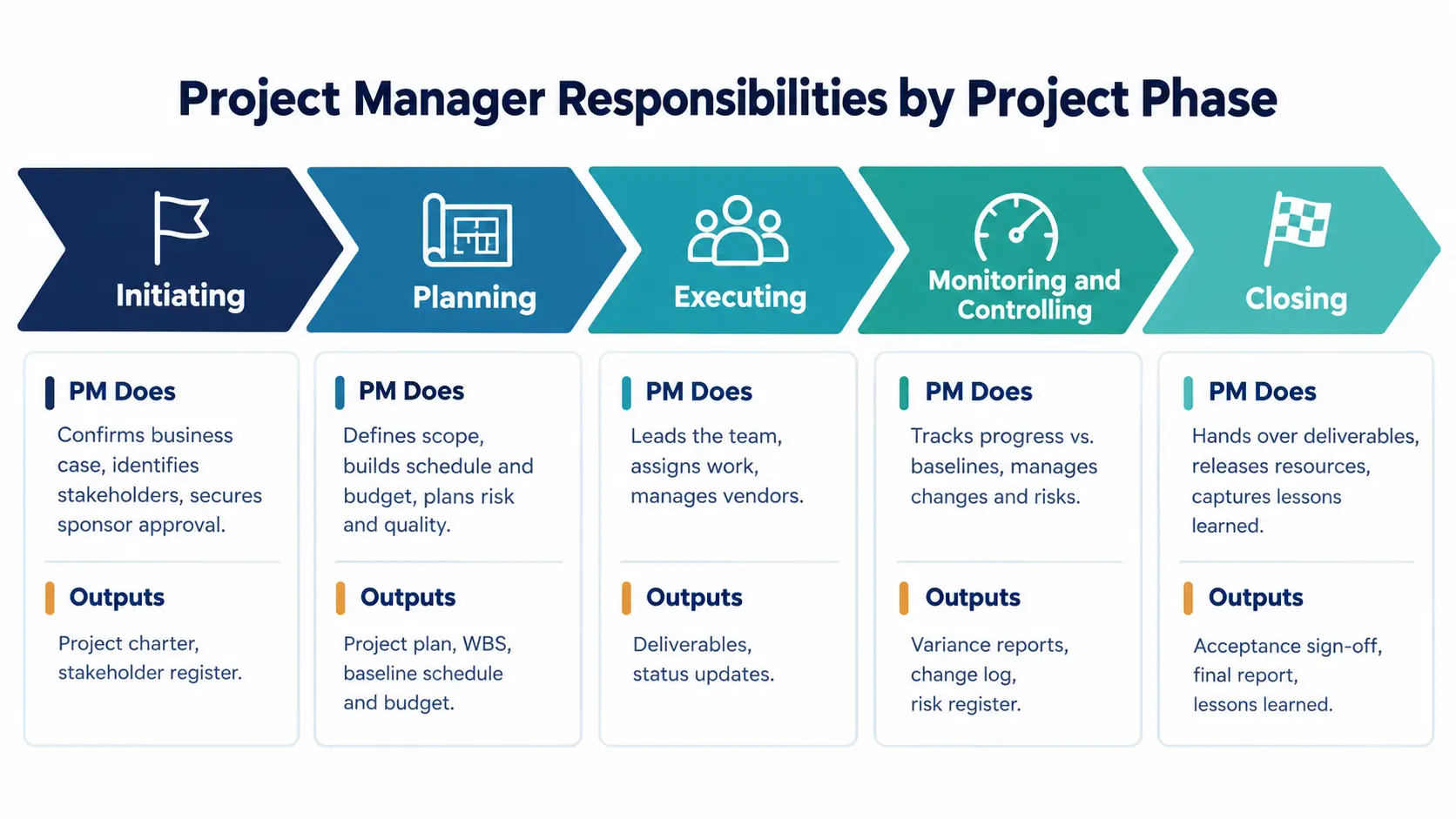
| Phase | What the Project Manager Does | Typical Outputs |
|---|---|---|
| Initiating | Confirms the business case, identifies stakeholders, and secures sponsor approval | Project charter, stakeholder register |
| Planning | Defines scope, builds the schedule and budget, and plans risk, quality, and communication | Project management plan, work breakdown structure, baseline schedule and budget |
| Executing | Leads the team, assigns work, and manages vendors and stakeholder engagement | Deliverables, status updates |
| Monitoring and Controlling | Tracks progress against baselines, manages changes and risks, and reports performance | Variance reports, change log, updated risk register |
| Closing | Hands over deliverables, releases resources, and captures lessons learned | Acceptance sign-off, final report, lessons learned |
Ultimately, a project manager's goal is to complete the project on time, within budget, and to the required quality standards. The duties below explain how they get there.
What Are the Key Duties of a Project Manager?
The core project manager duties are planning and scope definition, resource management, time and budget control, risk management, stakeholder communication, quality assurance, issue resolution, documentation and compliance, project closure, and team leadership. Together they cover every stage of a project, from the first scope discussion to the final lessons-learned review.
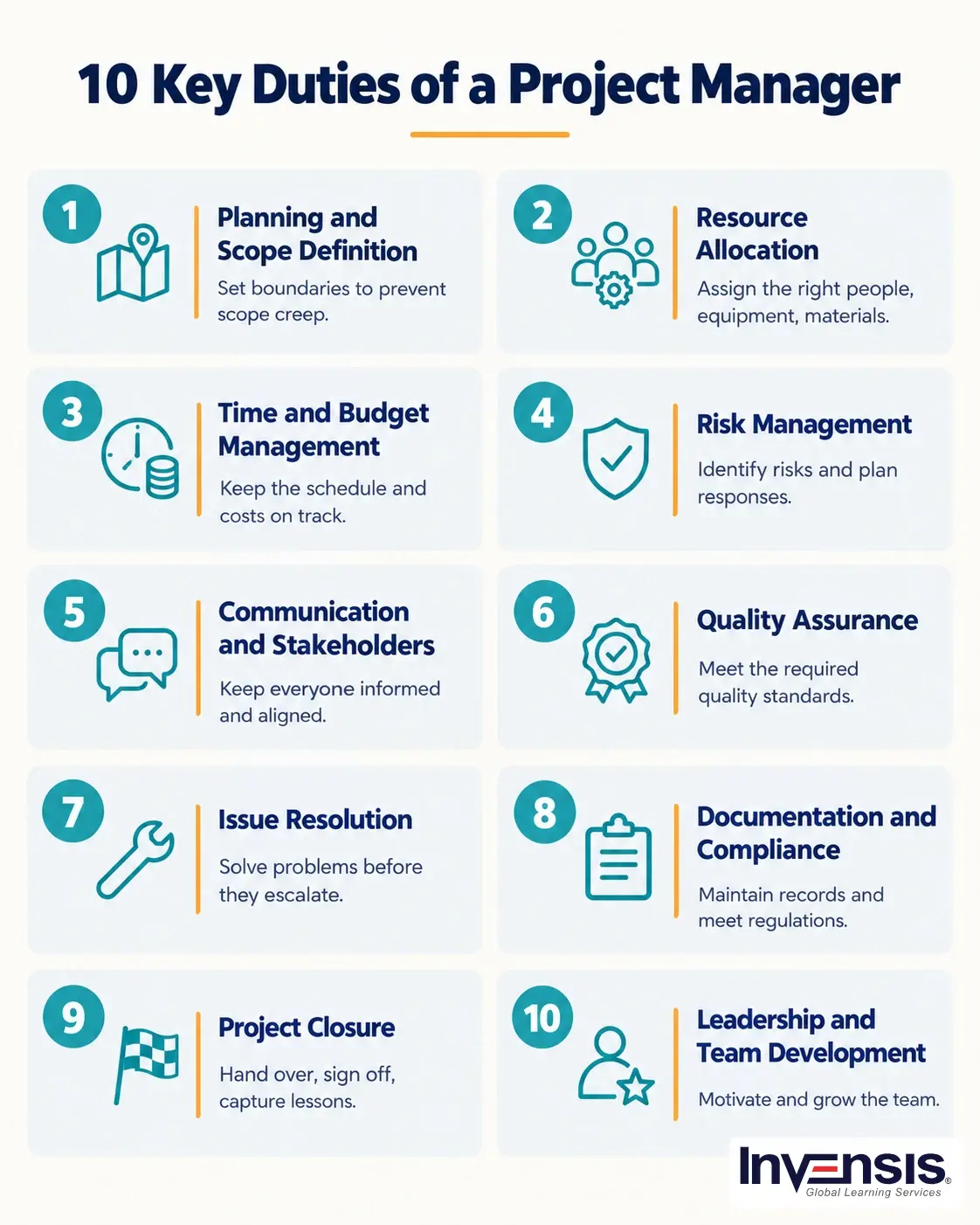
1. Project Planning and Scope Definition
Project managers own the initial and most important planning work. This involves creating a comprehensive project plan that covers what needs to be done, the resources required, the timeline, and the budget.
A critical part of this is defining the project scope, which sets the project's boundaries by stating what is included and what is not. This clarity is essential to avoid scope creep, which can derail a project. By setting clear objectives and expectations from the start, the project manager gives the project a solid foundation.
2. Resource Allocation and Management
A project manager must ensure the project has the resources it needs to succeed. This includes identifying the people, equipment, and materials required and assigning them appropriately.
Managing the team is part of this duty. The project manager provides direction, assigns tasks, and keeps everyone working toward the common goal, while adapting to changes in resource availability or project needs.
3. Time and Budget Management
Keeping the project on schedule and within budget is a central part of the role. This involves creating a detailed project timeline and monitoring progress to meet deadlines.
Budget management is equally important, as the project manager must track all expenditures to keep the project within its financial limits. Effective time and budget control requires careful planning, ongoing monitoring, and timely adjustments.
4. Risk Management
Every project carries risk, and the project manager's job is to identify risks early and plan responses. This involves assessing potential issues, such as resource shortages or technical difficulties, and preparing contingency plans in case they occur.
By managing risks proactively, the project manager limits their impact and keeps challenges from derailing progress.
5. Communication and Stakeholder Management
Communication is a vital part of the role. Project managers serve as the main point of contact between the project team and other stakeholders, including clients, management, and team members, and keep everyone informed about progress, issues, and plan changes.
Regular updates, reports, and meetings keep stakeholders aligned. Effective stakeholder management also means listening to feedback and addressing concerns promptly to maintain trust and collaboration.
6. Quality Assurance
Ensuring that the project meets the required quality standards is another important responsibility. This involves applying quality control measures throughout the project life cycle, conducting regular reviews, and making adjustments when needed.
The project manager also applies lessons learned from previous projects to improve current processes, so the final deliverables meet or exceed stakeholder expectations.
7. Issue Resolution
No project is without challenges, and the project manager must address issues as they arise. This can involve resolving conflicts within the team, overcoming technical challenges, or dealing with external disruptions.
A strong problem-solver makes quick, sound decisions that keep the project moving forward and minimize disruption.
8. Documentation and Compliance
The project manager maintains thorough documentation of activities, decisions, and changes, from the initial project charter to the final report. These records track progress and support compliance with legal, regulatory, and organizational standards.
Accurate, up-to-date documentation keeps the project organized, helps avoid legal or operational issues, and provides valuable insights for future projects.
9. Project Closure
As the project ends, the project manager oversees the handover of deliverables to the client or end users, confirming that all work meets the required standard and that the client accepts the outcome.
The project manager then runs a post-project evaluation to assess what went well, what could improve, and how those lessons apply to future projects. This supports continuous improvement in project management practices.
10. Leadership and Team Development
Leadership runs through every other duty. The project manager guides the team through the project's challenges while fostering a positive, collaborative working environment.
This involves motivating the team, providing support, and encouraging professional development. By investing in team members' growth, the project manager builds a stronger team that is better equipped for future projects.
Essential Skills Every Project Manager Needs
The duties above depend on a blend of people, planning, and business skills. Leadership and communication matter most because every other duty runs through them, followed by problem-solving, organization, time and risk management, and financial control. For a broader list, see this guide to project management skills.
1. Leadership
Leadership guides and motivates the project team toward its objectives. A good project manager inspires confidence, sets clear goals, and provides direction, creating an environment where team members feel supported and empowered to do their best work.
2. Communication
Effective communication is the backbone of successful project management. A project manager must clearly convey goals, expectations, and updates to team members, clients, and senior management, in both verbal and written form, to avoid misunderstandings and keep the project on track.
3. Problem-Solving
Problem-solving is critical for handling the challenges that arise during a project. A project manager must think critically, analyze situations, and find practical solutions to obstacles before they slow progress.
4. Organizational Skills
Organizational skills help a project manager handle multiple tasks, resources, and people at the same time. Keeping track of the moving parts produces a well-structured environment where tasks are executed efficiently and deadlines are met.
5. Time Management
Time management is about prioritizing tasks, managing schedules, and meeting deadlines. A project manager allocates time across tasks, avoids bottlenecks, and adjusts as needed to maintain momentum and deliver on time.
6. Risk Management
Risk management means identifying threats to the project's success and developing strategies to mitigate them. A project manager anticipates challenges and keeps contingency plans ready, which minimizes disruption.
7. Budgeting and Financial Management
Managing the budget controls costs and keeps financial resources working efficiently. A project manager must be skilled in budgeting, tracking expenditures, and making financial decisions that align with project goals to avoid cost overruns.
8. Business Acumen
Business acumen is the ability to understand the business context around a project, including strategy, finance, and how the work creates value. In PMI's 2025 Pulse of the Profession research with almost 3,000 professionals, only 18% showed high business acumen, yet that group met business goals on 83% of projects versus 78% for others and adhered to budget 73% of the time versus 68%, according to the PMI Pulse report.
9. Negotiation
Negotiation skills help reach agreements that benefit the project, whether with stakeholders, vendors, or team members. A project manager often negotiates resources, timelines, or contract terms while maintaining positive relationships with all parties.
10. Adaptability
Adaptability is the ability to adjust plans or strategies as circumstances change. Projects rarely go exactly as planned, so a project manager must stay flexible, pivot when necessary, and keep the work moving despite unforeseen challenges.
11. Technical Knowledge
Technical knowledge varies by industry but supports informed decisions. Understanding the technical side of the project helps a project manager communicate with the team, allocate resources sensibly, anticipate technical challenges, and confirm that deliverables meet requirements.
Project Manager vs Project Coordinator: What Is the Difference?
A project manager is accountable for the whole project outcome and makes the planning and trade-off decisions. A project coordinator supports the project manager by handling scheduling, tracking, and documentation. Many project managers start as coordinators, so understanding the difference helps you plan your next career step.
| Aspect | Project Manager | Project Coordinator |
|---|---|---|
| Primary focus | Delivering the overall project outcome | Supporting the project manager with administration and tracking |
| Accountability | Scope, schedule, budget, and quality | Assigned tasks and accurate project records |
| Decision authority | Makes planning, resourcing, and trade-off decisions within sponsor-approved limits | Limited; escalates decisions to the project manager |
| Typical tasks | Planning, risk management, stakeholder management, team leadership | Scheduling meetings, updating trackers, preparing reports, managing documents |
| Career stage | Mid-level to senior | Entry-level to early career |
Many coordinators build toward the project manager role through certification. The Certified Associate in Project Management (CAPM) suits early-career professionals, while the Project Management Professional (PMP) requires documented project leadership experience. This comparison of CAPM vs PMP explains which credential fits your stage.
How to Become a Project Manager in 2026?
To become a project manager in 2026, combine relevant education, hands-on project experience, core skill development, and a recognized certification, then keep learning as tools and methods evolve. The steps below outline that path in order.
1. Meet the Educational Criteria
Earn a Bachelor's Degree: While not always required, a bachelor's degree in business, management, engineering, or information technology provides a strong starting point. It builds knowledge of leadership, strategy, and resource management, which are vital for managing projects.
2. Gain Practical Experience
- Begin in Entry-Level Roles: Start with positions such as project coordinator, team member, or assistant project manager. These roles provide hands-on exposure to the day-to-day work of project management.
- Engage in Internships and Volunteering: Build practical skills through internships or volunteer projects that let you apply academic knowledge in real situations.
Side projects count too. These project management ideas show practical ways to build real-world experience before your first formal role.
3. Build Essential Skills
- Develop Strong Communication Skills: Improve both written and verbal communication so information flows clearly between your team and stakeholders.
- Refine Time Management Abilities: Prioritize tasks, set achievable deadlines, and manage your time effectively to keep projects on track.
- Strengthen Leadership Capabilities: Learn to inspire your team and steer them toward project objectives.
- Enhance Problem-Solving Skills: Practice tackling challenges early, before they escalate and stall the project.
- Master Stakeholder Management: Build and maintain positive relationships with stakeholders, clients, and team members to support project success.
4. Achieve a Professional Certification
Pursue Industry-Recognized Certifications: Credentials such as the Project Management Professional (PMP), PRINCE2, or the Certified Associate in Project Management (CAPM) validate your expertise and make you more attractive to employers. Structured PMP certification training helps experienced practitioners prepare for the exam.
If you are choosing between frameworks, this comparison of PMP vs PRINCE2 covers how the two approaches differ and where each is most valued.
5. Commit to Ongoing Professional Development
- Keep Up with Industry Trends: Stay informed about new tools, practices, and methodologies to keep your skills current.
- Participate in Workshops and Conferences: Seminars and conferences provide networking opportunities, expert insights, and exposure to new ideas.
Project Manager Job Description Sample
Use the template below as a starting point when writing or reviewing a project manager job description. Replace the bracketed fields with your own details.
Company Overview
[Company Name] is a leading [Industry Type] company dedicated to driving innovation, delivering quality, and promoting sustainability. We seek a talented and experienced Project Manager to join our team and lead critical projects that align with our strategic objectives.
Position Details
- Job Title: Project Manager
- Location: [City, State, Country]
- Job Type: [Full-Time/Part-Time], [Permanent/Temporary/Contract]
Role Summary
The Project Manager will oversee the entire project life cycle, from planning to execution, ensuring projects are completed on time, within budget, and to the required quality standards. This position requires strong leadership, exceptional communication skills, and the ability to manage complex, cross-departmental projects.
Key Responsibilities
- Project Planning and Goal Setting: Define project goals, scope, and deliverables that align with the company's business objectives, in collaboration with senior management and stakeholders.
- Project Plan Development: Create detailed plans that outline tasks, timelines, resources, and deliverables, and communicate them to clients and team members.
- Team Leadership and Coordination: Lead project teams, use resources effectively, and meet milestones while maintaining high quality standards.
- Progress Monitoring and Reporting: Monitor progress and provide scheduled reports on milestones, deliverables, and overall project status.
- Stakeholder Communication: Keep stakeholders informed of status, issues, and risks, and address concerns promptly.
- Budget and Risk Management: Manage budgets and forecasts to keep the project within the approved budget, and identify, assess, and mitigate risks throughout the project life cycle.
- Post-Project Evaluation: Conduct post-project reviews to identify successes and areas for improvement.
Educational Qualifications
- Bachelor's degree in Business Administration, Management, Engineering, or a related field
- A Master's degree or a certification such as the Project Management Professional (PMP) is preferred
Experience
- Minimum of [X] years of project management experience in [Industry/Field]
- Demonstrated ability to manage all phases of a project life cycle
- Experience in strategic planning, risk management, and change management is highly desirable
Required Skills
- Proficiency in Microsoft Office and project management tools
- Strong leadership, time management, and organizational skills
- Knowledge of change management and performance evaluation processes
- Excellent problem-solving, analytical, and negotiation abilities
- Ability to work well under pressure and meet tight deadlines
How Can Project Managers Stay Organized at Work?
Project managers stay organized by working from a clear project plan, using project management software, delegating well, building a realistic schedule, setting firm deadlines, and keeping communication open. These habits matter because a project manager juggles multiple tasks, deadlines, and unexpected issues at once.
Create a Project Plan
A project plan is a document that outlines a project's scope, goals, and deliverables, along with its timeline, budget, and required resources. It should also define roles and responsibilities for everyone involved.
A clear plan keeps you organized as work progresses and ensures everyone knows what they need to do and when.
Use Project Management Software
Project management software helps you track tasks, deadlines, and resources, and makes collaboration with team members and stakeholders easier. Compared with spreadsheets, dedicated tools offer real-time updates, customizable workflows, and access from any device.
Popular options include Microsoft Project, Asana, Trello, and Basecamp. Choose based on project size, methodology, and how your team prefers to collaborate.
Delegate Tasks Efficiently
Effective delegation lets a project manager spread work sensibly across the team. Break larger assignments into smaller, manageable tasks and give clear instructions and deadlines to the people taking them on.
Make sure team members have the information and skills they need. Good delegation relieves pressure on you and gives team members ownership of their work.
Create a Project Schedule
To build a project schedule, start with the budget, goals, and deliverables from your project plan. Identify every activity needed to complete the project and organize them in a Work Breakdown Structure (WBS) if necessary.
Next, determine the dependencies between activities and sequence them. Finally, estimate the time and resources each activity needs and confirm that your budget and timeline are sufficient, then share the schedule with your team.
Set Deadlines
Deadlines create urgency and help the team complete work within a specific timeframe. Without them, a project can become chaotic, and it is hard to hold team members accountable for their contributions.
Keep Communication Open
Open communication keeps an organized project running smoothly. Encourage questions, address concerns quickly, and make it easy for team members to talk with you and with each other.
Strong communication builds trust and a sense of teamwork, helping the group function as one team rather than a set of individuals.
Conclusion
Project manager roles and responsibilities span the full project life cycle, from defining scope and building the plan to managing risk, leading the team, and closing the work with lessons learned. By handling these duties well, project managers ensure objectives are met, stakeholders are satisfied, and the project delivers its intended value.
Mastering the role takes leadership, communication, organization, and business acumen, built through experience and structured learning. Your next step is to pick one skill gap from this guide and close it, whether through a stretch assignment, a certification, or project management training with Invensis Learning.
Frequently Asked Questions
1. What is the triple constraint in project management?
The triple constraint is the link between scope, time, and cost. Changing one of the three affects at least one of the others, so a project manager who adds scope must usually extend the schedule, raise the budget, or both. Quality depends on how well these three are balanced.
2. What is the difference between a project manager and a program manager?
A project manager delivers a single project with a defined scope, schedule, and budget. A program manager coordinates a group of related projects to achieve a broader business benefit, focusing on dependencies, shared resources, and strategic outcomes rather than day-to-day task delivery.
3. What is the difference between a project manager and a product manager?
A project manager focuses on how and when work gets delivered within a fixed start and end date. A product manager owns what gets built and why, guiding a product through its whole life based on customer needs and market strategy. The two roles often work side by side.
4. Who does a project manager report to?
Most project managers report to a project sponsor, a senior manager, or a Project Management Office (PMO), depending on the organization's structure. The sponsor typically approves the budget and major scope changes, while the project manager runs daily execution and reports progress.
5. Can you become a project manager without a degree?
Yes. Many project managers move into the role from coordinator, team lead, or technical positions after building practical experience. A degree in business, engineering, or IT helps, but demonstrated delivery experience and a recognized certification can open the same doors.
6. Is PMP certification required to work as a project manager?
No. The Project Management Professional (PMP) certification is not required for most project manager jobs, but many employers list it as preferred in job descriptions. It signals verified experience and knowledge of standard project management practices.